


On holiday break in Zakopane 1960
Barbara Levittoux was born in Warsaw on 29th December 1933, her parents were Wanda de domo Rybczyńska and Henryk Levittoux, the distinguished Warsaw surgeon, officer and pilot.
Barbara's parents met relatively late in life and it was a whirlwind romance. Henryk courted Wanda by taking her for air rides in an open avionette, performing corkscrews and turns until his date was sick on his collar.
It was the golden time in swinging Warsaw between the wars, alive with cabaret and theatres, film, poetry and music; they had a lively circle of friends. Henryk was an Ordinator of the Sport Medicine Clinic at the Warsaw University and practised privately in their flat at Polna 78. He took care of the Polish Olympic champion Janusz Kusociński and operated on his knee.
The outbreak of war destroyed this rich time of happiness.
He was the father Barbara never knew - she was 4 when, in September '39, he left the house never to return. Nothing was known about his fate for decades, the last postcard came from the prisoners' camp in Starobielsk - he was murdered with a bullet to the back of his head by ruzzians at the gaol in Charkiv.
Wanda suffered a deep shock and depression, and having to work long hours during the german ocupation, she sent Basia to the orphanage and school run by the Catholic nuns in Łódź.
The cruelty and hypocrisy of nuns contributed to Barbara's lifelong aversion to the church. She got to know and like Łódź, a city with textile traditions and later often returned to stock up on her materials.
After the war, she lived with her mum in a little flat in Żoliborz, a part of Warsaw, went to Sempołowska Liceum, and discovered the Tatra mountains.
They met with Jurek Świderski on the way to the Gąsienicowa valley shelter. Both were scouts and the songs sung by the campfires, being self reliant and inventive in the most challenging circumstances, friendship, fraternity, the ethos of fairness, decency, loyalty and scouts' ethics stayed with them for life - as well as being close to nature.
They never stayed in a hotel, it was always a tent.
He was a medical student, they climbed the high rocky Tatra mountains together, both on Polish and Slovakian sides, with lines and hooks, and after a few years got married. When their children came, the walks over to the Slovak side provided the much-needed cotton baby layette clothes, unavailable in Polish communist reality.
It was there also that they met and made lifelong friends with Domicella Bożekowska and Andrzej Goryński; years later, they moved into the close neighbourhood with their friends on Zatrasie, a part of modern Żoliborz.
She studied painting at the Warsaw Academy of Fine Arts in the class of Aleksander Kobzdej with the additional discipline of weaving and tapestry, at the class with Wojciech Sadley. After the Academy she worked for a while at the Instytut Wzornictwa, the Design Institute, and then joined the artist cooperative Wzór, all along working artistically, initially mostly on her painting, joining often the group trips with fellow students to beautiful destinations like Kazimierz, producing oil paintings of little simplified town houses in broken earthy reds and greens. She graduated in 1958, the year her daughter was born. "Wzór" (Design)was a cooperative of artists whos aim was to provide the grim and grey socialist market with some individually and artistically designed objects, while earning money in a system that did not have an art market. For years, she would paint the kilometres of curtains with free "Picasso" design, later she designed and produced quantities of clothes, blouses, dresses for sale, to earn a living. The raw materials for these were sourced in Łódź, bought in bulk in factory shops and hauled over by train on day trips. Not only did she "sew up" the whole house - lampshades, bedclothes and curtains, but the off-cuts from sewing found way to her art (Ćma)
Gradually, her palette in painting was becoming more sparse and limited to the shades of white, and more textural, often the paint was squeezed straight from the tube to shape cobblestones, or the texture of walls, for example.
After marriage Basia and Jurek lived in Jurek's parents' enormous flat at Nowogrodzka 3 m 12 in a beautiful, pre-war, undamaged part of Central Warsaw. It wasn't a happy cohabitation, Barbara did not get on with her in-laws. Jerzy went to America to study cardiology at Harvard University and she was left alone with a baby in a cavernous, old fashioned flat she didn't like, with tiled stoves fired by coal that had to be carried from the cellar, and two eccentric old people each with their own tragic war luggage - older of 10 years son Bohdan - Danek - was murdered by the germans in the first days of the Uprising in a particularly sadistic way: captured with two other young boys they were tied, laid down driven over and crushed by the tank. The Mother and Father in law hardly spoke, Dr. Swiderski kept a live-in lover, assistant to his bacteriology lab and medical analysis studio on the premises.
One blessing was that Edward Świderski loved his little granddaughter very much and spent lots of time showing her the wonders of natural world, the butterfly emerging from paupae, reading the Polish classics to the toddler and even cooking - otherwise the little girl was left with nannies, the young women from the country in search of boyfriends, that changed over frequently - while Barbara worked.
Soon Barbara managed to move her young family to the newly built quarter in familiar Żoliborz - Zatrasie.The hastily constructed estates were cement deserts in the fields of rubble, one house looking exactly like the other, grey, crude, raw cement blocks without finish, paths in the rubble leading to school and shop.
A few blocks away, Lilka - Domicella Bożekowska - was starting her amazing, against-all-odds forest garden on the ground floor of their sculpture studio flat. But it was their own home, on the 4th floor with no lift, with a balcony and central heating.The old-fashioned palatial flat of the grandparents was lost to the aggressive communist council policy that would forcibly take over elegant places in central Warsaw, giving them to communist activists. Jerzy's parents were soon ferried away to the old people's homes, where they died. Barbara for few years after, went back to the flat clearing/throwing out the lifelong collections of books, documents, artefacts, memories, medical equipment, butterflies collections - everything that belonged to a settled Warsaw medical family that were her in-laws. There were a few other historical properties, like a house in Podkowa Leśna and the property in Kodeń nad Bugiem, that she disposed of, without regret - such was her wrath.


On the way to Litworowy, Tatra mountains 1956

The last postcard from Starobielsk ruzzian camp for the Polish officers from Barbaras father Henryk Levittoux
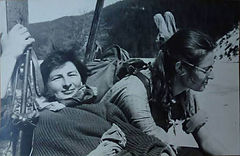


Barbara, in stripy dress, with Hanna Jung, long term friend and fellow painter - Hanka died relatively young, she was perhaps Barbaras closest confidante
with Domicella Bożekowska, a lifelong friend, in Tatra mountains
Barbara was keenly interested in plants, in fact it was a toss between botanics and art that she was going to study.
Art prevailed - her mother, Wanda, offered a banknote to the saint in the church on the day of the competitive entry exam.
She studied with artists who later became known - Jacek Sienicki, Franciszek"Byk"Starowieyski, Wiesław Kruczkowski, Hanna Jung.
The love of plants and longing to own a garden were to be unfulfilled for many more years. She walked the pretty streets of the old Żoliborz, with big stylish villas set in their gardens, looking wistfully at rampant flowering wisteria and overflowing climatis and the quest to bring these two particular favourites to flower in her own garden years later were a serious matter.
in the meantime, the balcony and the top floor landing in the block of flats became the oasis of greenery.
Growing plants from cuttings, layerings, seeds she created her own garden in the final family home.
She had green fingers and gardening was a life-long quiet passion, that suited her contemplative disposition. She could be very gregarious when in company of old friends, but with strangers and in public Barbara was shy.
Although there was no free art market, one may argue for the better, at that time in Poland, there were other ways of supporting and promoting artistic activity and interests.
The state provided an administrative network of institutions with exhibition room, transport, funds for catalogues, curators that would write about artists and their work.
If it lacked the "frisson" of an open market and its competitiveness, it provided stability and base.
Barbara Levittoux was always well integrated in a friendly, informal company of other artists, and, over time, many spontaneous self organised art groups of people with shared interests were also created ( like the group called IXION).
Some were short- lived, but they provided opportunities for cross- pollination of ideas and interesting shows.
Perhaps the most exciting of all were the artistic plain-air(plenery) outings.
They were a few weeks long late summer camps in sites offered to artists union by big industrial plants on their holiday estates in the forest, by the lake. Plenery in Lubniewice were momentous.
The factory provided free industrial scrap materials: fabrics, plastic, threads; good company, air, freedom, beautiful scenery and some wine resulted in a riot of artistic ideas, some site specific - long before the land art earned its name.
The plainair were open to artists from outside Poland; the friendships were forged that allowed for further inntersemination of ideas, artistic exchanges and shows in other countries.
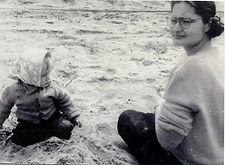

Barbara with her daughter, future painter Malgosia Levittoux
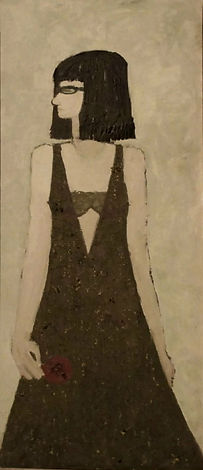
Self portrait as an Egiptian
Her work was never connected with the folk craft of weaving, although she learned, as per curriculum, the traditional techniques like gobelin, that would pop up in her art (White Tree). There was a state supported cooperative of folk crfts and arts, very successful, called Cepelia, whose ceramics, furniture ,weaving and arifacts were much sought after if a bit populist. She was drawn perhaps to a wider, international modernism that was still remembered from before the war and detectable under the socio-realist forced routine of the 50ties and sixties. Artists, particularly the group connected with Łódź, constructivism of Kobro, Strzemiński, Jarema in Kraków, left their imprint, even though in the era of social realism under comunism the modernism was looked down upon as a rotten imperialist art officially not mentioned and ignored/forgotten.
The simplicity, poverty of form of Barbara's work hark back to this aesthetics, art that did not depict, but rather organised physical space and materials. Neither was it in political opposition to the system and its grim absurd stupidity, embracing a cause as a vehicle; hers was a quiet, straightforward aesthetic individual quest for space, rhythm, light in compositions.
It was a very busy time when children were small. She never stopped working. They would be ferried piggyback away to kindergartens and schools, with the after-lessons activities lined up that would keep them out of trouble till early evening(or so she thought). The cooking and cleaning were done by the house help, Pani Irena - there was always a house help, even though it was a flat in a block on the 4th floor without a lift, the wooden floors were polished and glanced.
Barbara had a studio allocated by the council (spółdzielnia mieszkaniowa WSM), first it was a small room on the ground floor in a little street ul. Suzina, a walk away from the Broniewskiego st flat, later moved to a bigger, higher ceiling and brighter space on the top floor in Próchnika 8D. This is where her big, some 4-5 meters high, enormous textile sculptures were created, almost on instinct as they were too big to be hung out.
In between the studios, she was weaving at home in a 2-bedroom flat on the 4th floor of the block of flats on ul.Broniewskiego 11 with two small children, a husband who needed his own study to write medical books and a dog. The dog was a permanent family companion, since her own girlhood mutt called Pim, who famously swam across the Vistula River.
Her work was so unorthodox, austere and understated that it went almost unnoticed. Very few people were tuned in to this kind of poor, made of cheap materials, crude, raw aesthetics; this had to grow on wider public.
The friends were important. In the first decade after the Academy, a very close friend was the painter Hanna Jung, and another textile artist, Alina Lefeldowa.
Barbara got a 1st prize, though, for the more classic tapestry celebrating the Olympics. The prize was an enormous sum of 30 000 złoty. She entered many available competitions, national and international. This is how the participation in Lausanne Biennale in Switzerland came about, and the miniature shows in Szombathely, Hungary - the venues that eventually proved the most important showcase and peer support for her kind of art. She would prepare the work for the Biennale, which was juried, and would always be voted in - this was an incredible boost for morale, and the other artists submitting work became a worldwide community.
Gradually, she was taking her place. Not very outspoken and shy, every important show was a challenge.
This is one of the few things that she wrote about her work: "Art is a deeply personal matter. The need to display one's works in public view borders on exhibitionism. Therefore, an exhibition is a difficult experience. However, it is a necessity for the artist, an opportunity to see the work in a different setting, test it, and confront it with other people's opinions. Some works lose, others gain. We learn from mistakes and achievements. Mistakes usually become apparent after a while. But it's good to recognise them. Work requires both modesty and self-confidence. Modesty alone paralyses. Too much self-satisfaction leads astray."
Yet another way of earning money opened up with the collaboration with the theatre stage designer Łucja Kossakowska. Ms Kossakowska would prepare the overall plan for the decoration, and ask Barbara to execute particular elements, like Renaissance Portraits, that were to play an important role in the overall design. These were made by the method of application, machine-sewing of shaped bits of different fabrics with their colours and texture expressively describing the subject or pattern, onto a stretch of larger cloth. This collaboration lasted several years, Barbara's applications appeared in many Warsaw operas, in Rossini's Cinderella & in Italians in Algier, Mozart's
Die Entführung aus dem Serail, in Händels Messiah -
and gave her ideas for some of her own artistic work(Seaweed I, 2005 double sided textile application collage)

Barbara, with her small son Wojtek and the dog Aga, (Agusia), working in the room of the family flat on Broniewskiego st

The Olympic Flags Tapestry won Barbara the first prize in the state competition and was bought by the Museum of Sport and Tourism in Warsaw, the duplicate is in the Museum of Sport in Lausanne

On the plener in Lubniewice. Husbands and dogs tugged along, mushrooms were gathered, beer drunk

& more.